The stars get brighter the further out you go
· 5 min
The game does tell you where you are. There is a chart with the planets you have reached drawn bright and the ones you have not drawn faint, and a thin strip under the play area showing where you sit between one world and the next.
None of that tells you how far from home you are. The colour does, and it never mentions it.
Two things happen to the sky, in opposite directions
Every leg of the voyage has its own palette. Two numbers in it move from Earth outward, and they move against each other.
The first is how much of the background you can see. On the way to Mars the dial that fades the distant structures and the drifting debris sits at 0.55 — there is a lot of world back there, and it is lit. By Pluto it is 0.16. The far layers have not been removed, they have faded almost into the void, and a hull becomes the only solid thing on the screen.
The second is the starfield, and it goes the other way. It starts at 0.30 in the warm ochre light of the first leg, where the sun is close enough to wash most of it out. At Pluto it is 0.85, the brightest of all seven. The dark did not take the stars away. It is what let you see them.
It is one trick, and it stops being subtle once you know: you lose the world and you gain the sky.
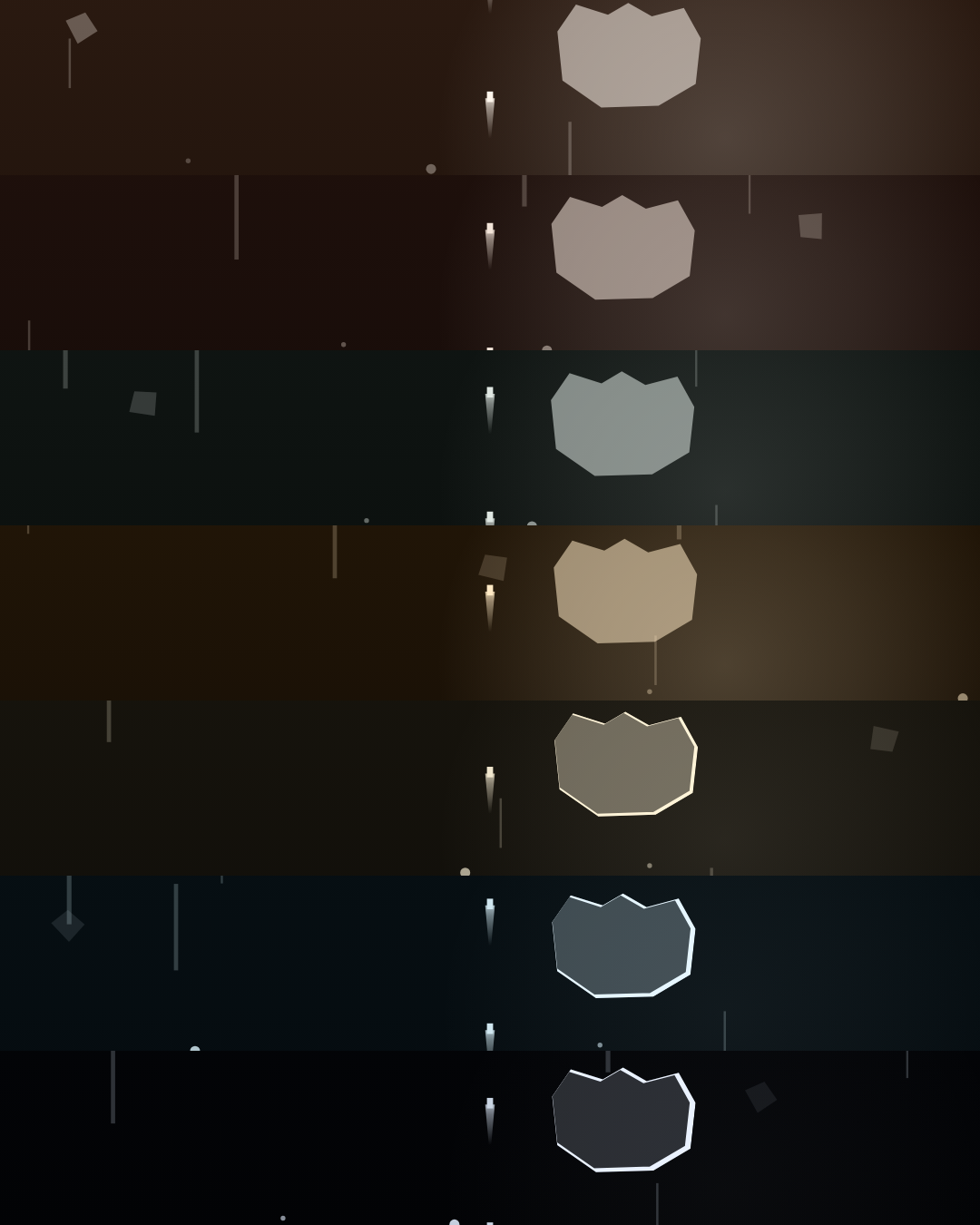
That is the same rock and the same ship, seven times. Nothing about the shapes changed.
Except at Saturn, where it briefly reverses
The steady march has one interruption, and it is the most interesting number in the set.
Each leg has less nebula in it than the one before, thinning as you leave the inner system — until Saturn, where it goes back up to 0.22, higher than anywhere else in the voyage including the run out from Earth. The stars dim at the same time. You are inside the weather rather than looking at it from outside, and for one leg the sky closes back in.
Then it opens again, further than before.
The light starts arriving from one side
There is a third change, and it happens exactly once.
It starts on the way out of that same storm, which makes Saturn the hinge of the whole voyage: the murk peaks arriving, and the light changes character leaving.
On the first four legs everything is a shape filled with a colour, evenly, and that is all. From Saturn outward every enemy hull, and every planet, also catches a hard edge of light down one side — at almost the same angle each time, 210 degrees then 205 then 200, as though there is a single distant source out there and everything has turned slightly towards it.
The fill goes the other way to meet it. On the same three legs the foreground shapes are filled at 72%, then 50%, then 34% — so as the edge arrives, the body it belongs to fades. By Pluto a rock is a dark mass held together by a white line down one side of it, on a background that is nearly the same black.
The one exception is your own ship, which stays at full strength the whole way. Reading a shape by its edge is the art direction; losing track of which shape is you is not. So the last leg is dark things with lit edges, and one bright thing that is you.
Why it is a colour and not a number
A percentage would be more precise and would tell you nothing.
The change is slow enough that you never catch it happening. You notice late — you look up from an episode and realise the rocks are harder to pick out than they used to be, and that this has been true for a while. A number tells you how far you have come. A colour tells you how far you are from home, which is a different question and the one the game is about.
It is also close to free to build. The authored art is twenty shapes, and every ship in the game is one outline filled with one colour — except the first leg's boss, which has three viewport slits punched out of it, so the void shows through. Change the palette and all of it recolours at once: the ships, the debris, the chart, the interface. There is no second art set for the outer system — there is one set of shapes and seven ways of lighting them.
What you can actually reach today
Two of the seven. Earth to Mars, and Mars into the Belt.
The other five palettes exist and the episodes that run through them are being written. Worth saying plainly, in a post about a voyage most of which you cannot take yet.
Start at Earth, where it is still bright. The first leg is the warmest light in the game, and nobody notices it going.